





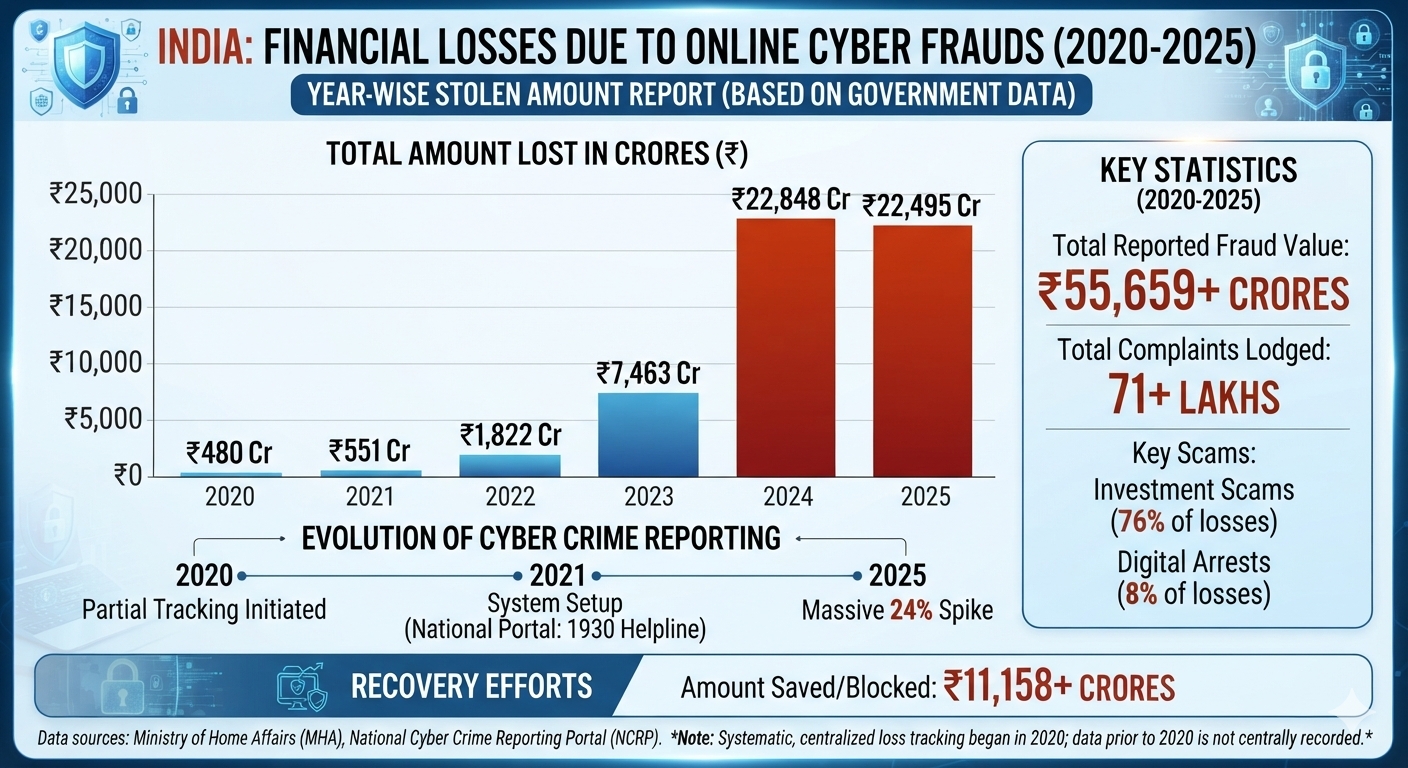
EXPERT GRAPH BUSINESS NEWS EXCLUSIVE: Cyber Frauds Siphon ₹55,659 Crore from India; Corporate Ecosystem on High Alert
A staggering ₹55,659.81 crore has been siphoned off by cybercriminals in India over the past six years, according to data compiled by the Ministry of Home Affairs (MHA). Driven by rapid digital transformation and the hyper-adoption of smart devices, online financial fraud has transformed from a localized nuisance into a sweeping threat to national economic security.
Official tracking logs from the National Cyber Crime Reporting Portal (NCRP) reveal that an overwhelming 80% of these monumental losses materialized in the last two years alone. This highlights an explosive surge in highly sophisticated engineering scams targeting both individual consumers and corporate digital nodes.
The Six-Year Trajectory of Financial Damage
Prior to 2020, data regarding nationwide digital theft remained heavily fragmented across regional police departments. Central authorities primarily logged the volume of server breaches rather than tracking individual rupee losses. The setup of centralized monitoring frameworks in 2020 completely changed how digital crime metrics are observed:
- 2025: ₹22,495 crore lost across 28.15 lakh officially registered complaints.
- 2024: ₹22,848 crore lost via 22.68 lakh complaints, representing the absolute peak of total stolen capital.
- 2023: ₹7,463 crore lost, marking the beginning of the hyper-growth phase.
- 2022: ₹1,822 crore lost as digital payment ecosystems expanded post-pandemic.
- 2021: ₹551 crore lost during the baseline initialization phase of centralized tracking.
- 2020: ₹480 crore lost under a newly deployed partial reporting model.
While law enforcement interventions marginally contained the financial damages in 2025 compared to the prior year, the actual volume of cyber incidents spiked by a worrying 24%. This shows that syndicates are launching attacks at an unprecedented scale.
🔍 Anatomy of the Scams: Where is the Money Going?
Intelligence gathered by the Indian Cyber Crime Coordination Centre (I4C) highlights that modern fraudsters have abandoned basic phishing links in favor of highly organized, multi-layered psychological operations. Three primary vectors account for the vast majority of stolen funds:
- Trading and Fake Investment Traps (76% of Losses): The single largest driver of digital fraud losses. Scammers manipulate targets via messaging groups. They utilize cloned trading applications that display simulated profits to induce massive capital deposits before freezing the accounts.
- “Digital Arrest” Scams (8% to 9% of Losses): The fastest-growing psychological exploit. Organized syndicates leverage AI deepfakes, forged warrants, and spoofed video calls to impersonate officers from the CBI or Enforcement Directorate. They hold citizens in absolute isolation until they clear their life savings.
- Identity Theft & UPI Violations: Fraudsters weaponize compromised SIM configurations and malicious links to bypass Unified Payments Interface (UPI) security protocols, draining unsuspecting consumers within minutes.
Geographically, the financial impact is heavily concentrated. A recent state-wise analysis shows Maharashtra leading the national loss table at ₹3,203 crore, closely followed by Karnataka (₹2,413 crore), Tamil Nadu (₹1,897 crore), Uttar Pradesh (₹1,443 crore), and Telangana (₹1,372 crore). Together, these five digitally progressive states shoulder more than half of the country’s total financial damage.
🛡️ Defensive Countermeasures and Capital Recovery
In response to the escalating crisis, the central government has scaled up defensive infrastructure, allocating ₹782 crore specifically for cybersecurity projects under the recent Union Budget.
The primary line of citizen defense remains the 1930 Cyber Helpline, integrated directly into the Citizen Financial Cyber Fraud Reporting and Management System (CFCFRMS). This real-time banking communication framework has successfully blocked and saved over ₹11,158 crore from entering muddy mule accounts since its launch.
Furthermore, coordinated inter-agency operations have proactively deactivated more than 3.4 crore suspicious telecom lines, disabled 83,668 fraud-linked WhatsApp profiles, and frozen 59 lakh compromised bank accounts. Security analysts warn that while state mechanisms are rapidly expanding, corporate and public awareness of psychological manipulation remains the ultimate shield against global cyber syndicates.
NOTE: We are publishing this information based on data received through various online and official public sources. The actual stolen amounts can be somewhat different, higher, or less than estimated here. However, the main focus of this news coverage is to alert people and online users to be cautious, protect themselves from evolving threats, and secure their hard-earned money.