




One such model is ShaleenJobs.in, the online recruitment platform operated by Shaleen Management Consultants, which has been working with corporate clients since 2002.
According to the company, it has worked with 10k+ corporate clients locally and across India and has developed a recruitment system designed to combine the experience of a traditional recruitment consultancy with the advantages of an online hiring platform.
The traditional recruitment model is effective but often transaction-based.
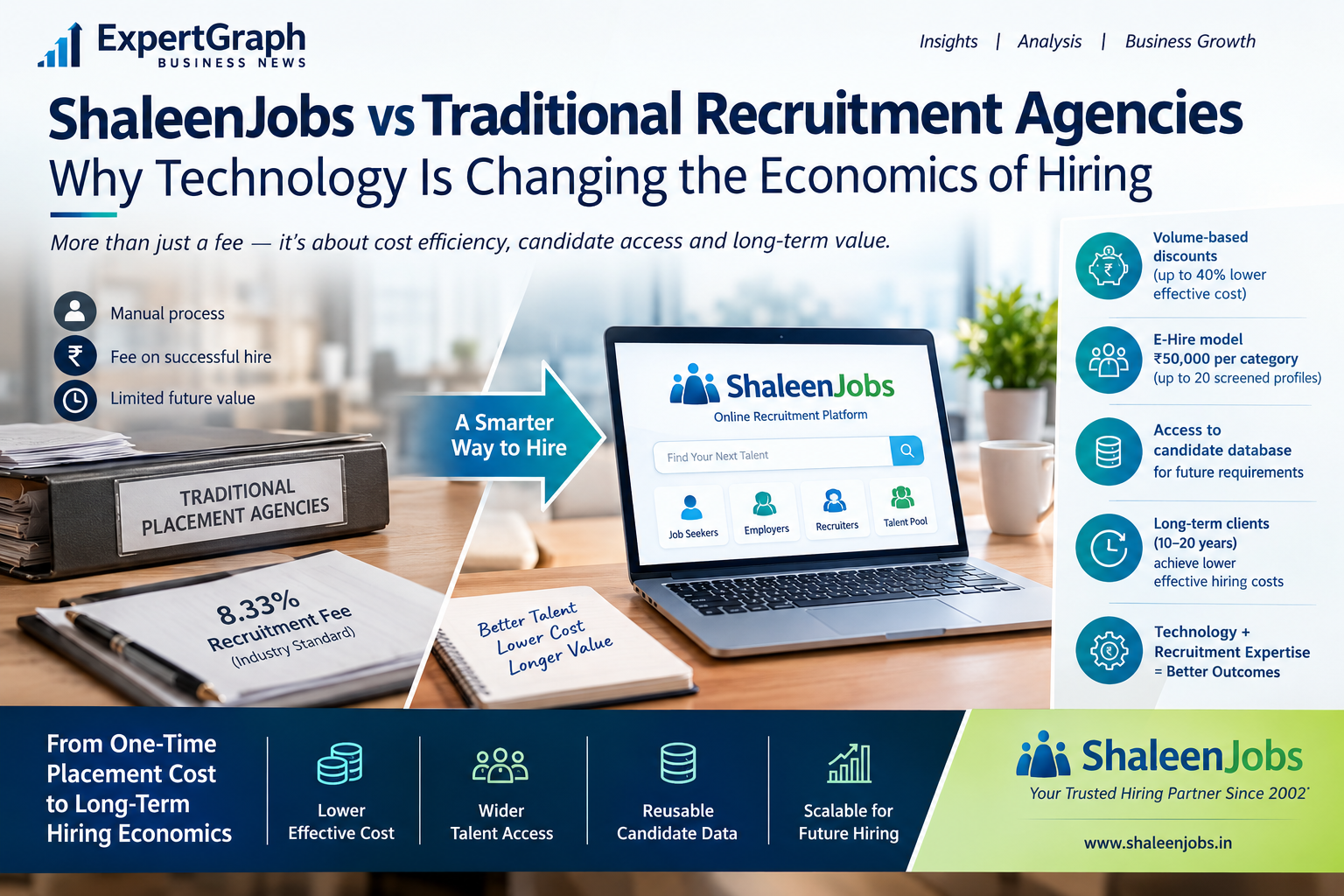
Traditional placement agencies generally operate on a percentage of the selected candidate’s salary or CTC. A commonly used benchmark in the recruitment industry is around 8.33% of annual CTC, although actual commercial terms vary depending on the position, industry, seniority, volume, and agreement between the client and recruitment firm.
For a single or occasional recruitment, this model can be straightforward.
The challenge can arise when a company has multiple vacancies or recurring recruitment requirements. In such cases, organizations may need to repeatedly pay recruitment charges for candidates even though the recruitment agency may already have access to relevant candidate information from earlier searches.
This raises an important business question:
Should recruitment be viewed only as a cost per successful selection, or should companies also consider the long-term value generated from the hiring process and candidate data?
ShaleenJobs takes a different approach.
ShaleenJobs combines recruitment consultancy services with an online recruitment platform.
Instead of relying exclusively on a manual consultant-to-client process, the platform allows recruitment activity, applications, and candidate information to remain within a structured digital system.
This can potentially provide companies with benefits beyond a single recruitment transaction.
The company’s standard recruitment model may be based around the industry-standard 8.33% fee, but ShaleenJobs says its commercial structure also allows companies with larger requirements to explore volume-based and fixed-cost models.
Volume-based discounts
For companies with multiple positions, ShaleenJobs has a volume-based discount mechanism. Depending on the overall billing and recruitment volume, the company says the effective recruitment cost can be reduced by up to approximately 40% compared with the standard fee.
The actual commercial benefit depends on the client’s requirements, number of positions, and agreed terms.
This makes the model particularly relevant for companies with continuous or large-scale hiring requirements.
E-Hire: a fixed-cost model for multiple positions
Another option offered through ShaleenJobs is its E-Hire model.
Under this model, the recruitment team works specifically on a particular job category and processes up to 20 relevant, screened, and approved interview profiles for a fixed fee of ₹50,000 per category.
For organizations recruiting several people for the same category, this can change the economics of recruitment considerably.
For example, rather than paying a percentage-based fee separately for every successful appointment, an organization can use a fixed-cost recruitment process for a category and receive a defined pool of screened candidates.
The effective cost per appointment therefore depends on how many candidates are ultimately selected from the processed profiles.
The bigger advantage: recruitment data can continue to create value.
One of the important differences between a digital recruitment platform and a purely manual recruitment relationship is the ability to maintain recruitment information within a structured system.
When applications are received through ShaleenJobs. in, candidate information can remain available in the recruitment ecosystem for future requirements, subject to the platform’s terms, candidate permissions, and applicable privacy requirements.
This creates a potential long-term database value for employers.
A company recruiting for a particular position today may have similar requirements six months or one year later. Instead of starting the sourcing process entirely from the beginning, an online recruitment database can provide an additional source of candidates for future vacancies.
This is where the economics of recruitment can change.
The real cost of recruitment may be lower than the first invoice suggests.
Consider a company that regularly recruits for the same categories.
Under a purely transaction-based model, the company may pay a recruitment fee every time a candidate is successfully hired.
Under a technology-enabled recruitment model, however, the company can potentially benefit from:
- Previous applications
- Existing candidate profiles
- Searchable recruitment data
- Repeat access to relevant candidates
- Digital job applications
- Structured recruitment records
- Screening and shortlisting processes
- Volume-based commercial arrangements
- Fixed-cost hiring options such as E-Hire
Therefore, the appropriate comparison may not simply be
8.33% vs. ₹50,000
Instead, companies should examine:
Total recruitment expenditure ÷ total hiring output + long-term value of the recruitment database and technology
Why long-term clients can potentially achieve better hiring economics
ShaleenJobs says that a number of its clients have been associated with the organization for 10–20 years.
Long-term relationships can create efficiencies because recruitment is no longer treated as an isolated requirement. The employer and recruitment platform gradually develop familiarity with job categories, candidate profiles, locations, and hiring patterns.
For companies with recurring recruitment requirements, this continuity can potentially reduce the time and effort required to restart the hiring process for every vacancy.
The database generated through previous applications can also become an additional recruitment resource for future requirements.
This creates a fundamentally different proposition from a one-time placement transaction.
Technology + recruitment expertise
The bigger development in the recruitment industry is not necessarily the replacement of recruitment consultants by technology.
Rather, the emerging model is the combination of recruitment expertise and technology.
Traditional recruitment consultants bring market knowledge, candidate relationships, screening experience, and employer understanding.
Online platforms bring scalability, searchable databases, digital applications, data management, and repeat accessibility.
A platform such as ShaleenJobs attempts to combine both elements.
For employers, this can mean that recruitment becomes not only about finding one candidate for one vacancy but also about developing a repeatable hiring system.
What should employers compare before selecting a recruitment partner?
Companies evaluating recruitment agencies and online recruitment platforms should consider more than the headline percentage.
Important questions include:
- What is the effective cost per successful hire?
- Are volume discounts available?
- Is there a fixed-cost model for multiple positions?
- How many screened candidates are included in the service?
- Can previous applications be searched for future requirements?
- Does the recruitment partner provide technology and database access?
- How quickly can recurring vacancies be handled?
- What replacement or post-selection support is available?
- Can the model scale when hiring volumes increase?
- What is the total cost over a 12–24 month hiring cycle rather than for just one vacancy?
These questions can give employers a more realistic picture of the commercial value of their recruitment partner.
From placement agency to long-term hiring partner
The recruitment industry is gradually moving from a placement-fee model towards technology-enabled recruitment ecosystems.
ShaleenJobs represents one example of this transition, combining its recruitment consultancy experience since 2002 with an online recruitment platform.
Its proposition is that employers should not look only at the standard 8.33% recruitment fee. Depending on the hiring requirement, volume-based discounts and fixed-cost models such as E-Hire may provide a different cost structure.
More importantly, maintaining recruitment applications and candidate information within a digital platform can potentially create value beyond the first hiring transaction.
For companies that recruit regularly, the question is therefore no longer simply “What percentage does the recruitment agency charge?”
The more relevant question may be:
“What will be my total hiring cost, and what long-term recruitment value will I receive from the system?”
That shift—from one-time placement cost to long-term hiring economics—could become increasingly important as Indian businesses move towards technology-driven recruitment.